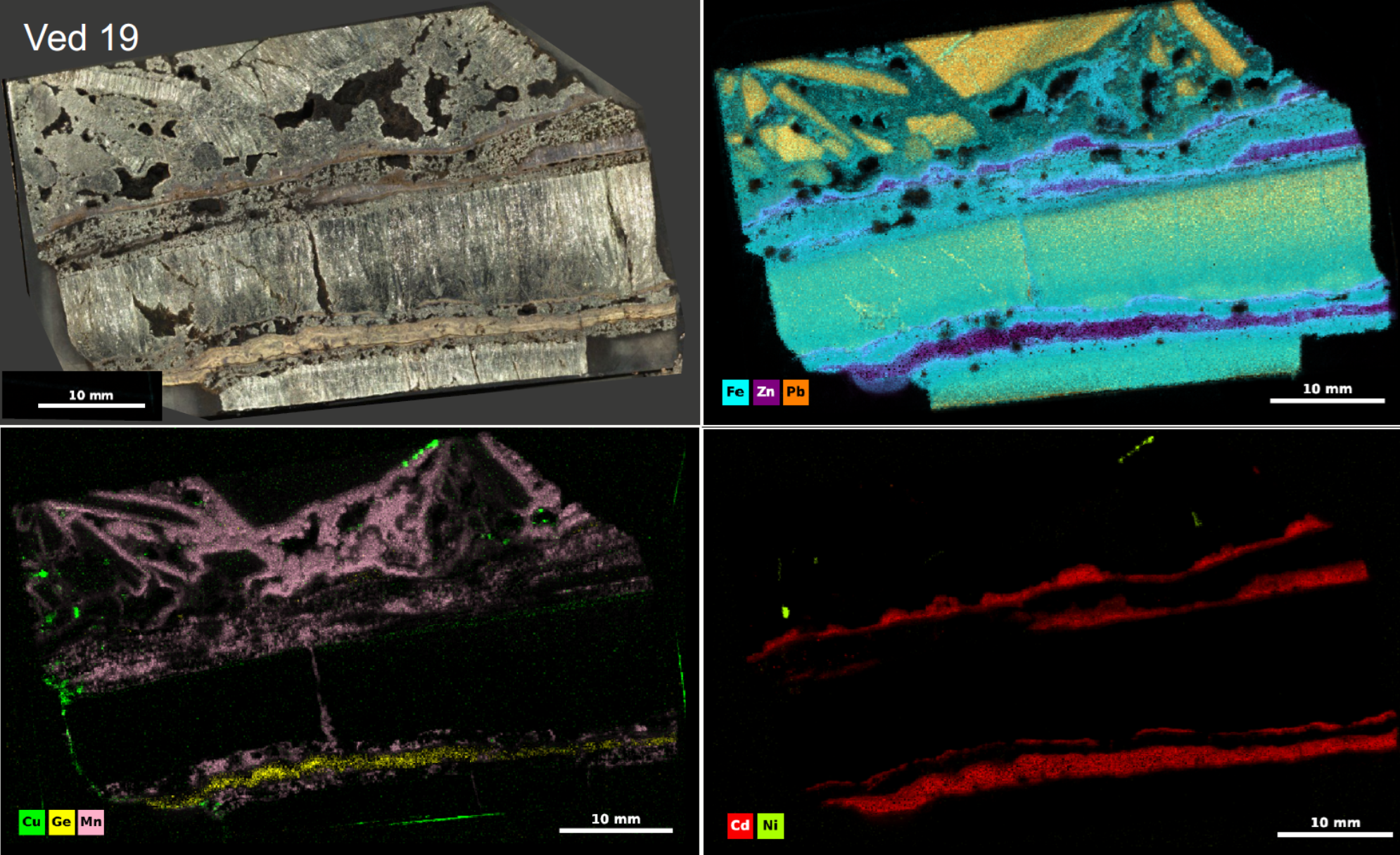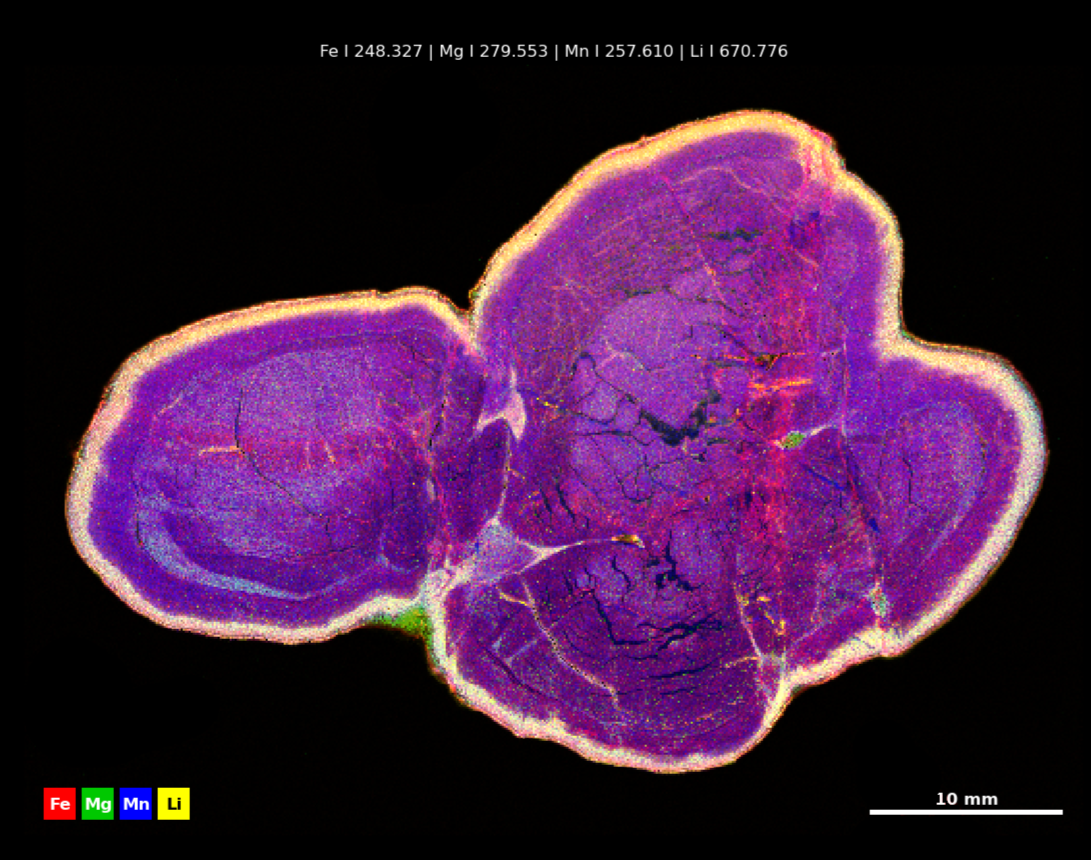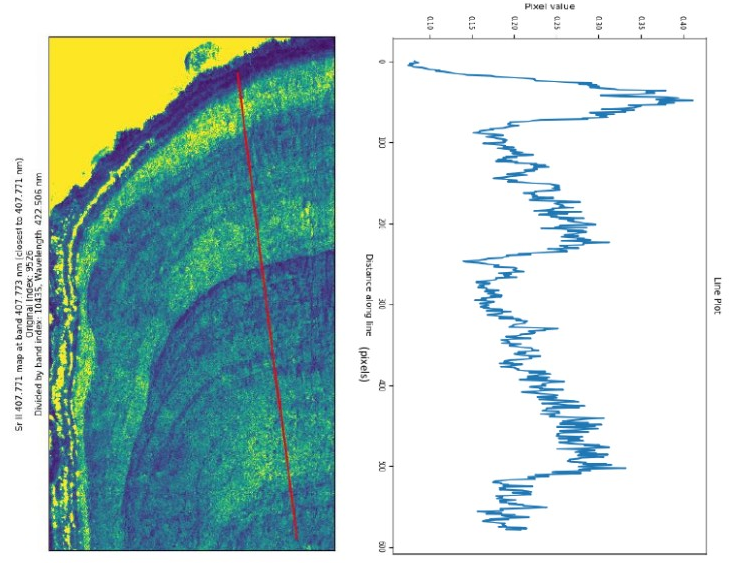
High-resolution, chemical imaging of rocks, ores, drill cores and geomaterials. A single laser pulse reveals the elemental fingerprint of a sample — mapped point by point, from major elements to traces.
Continuous spectral coverage
Mapping resolution (up to)
Maximum sample size
Laser-Induced Breakdown Spectroscopy is a fast, minimally-destructive technique for measuring the elemental composition of a material. A focused, high-energy laser pulse ablates a microscopic spot on the sample, creating a high-temperature plasma. As that plasma cools, each chemical element emits light at characteristic wavelengths — a spectral barcode that tells us what the sample is made of and how much of each element is present.
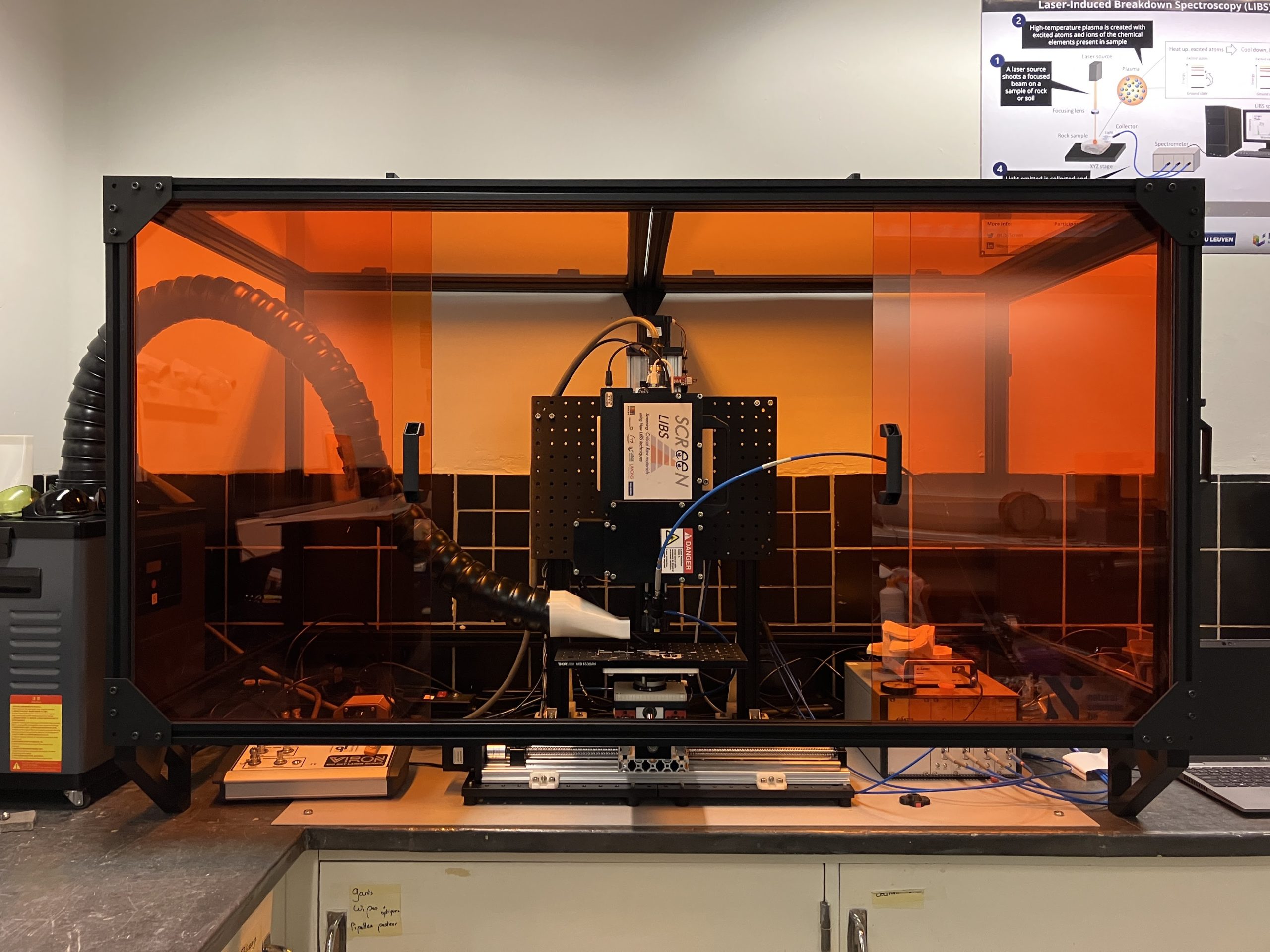
The benchtop LIBS mapping system in the GSB laboratory.
Our system couples a pulsed Nd:YAG laser to a six-channel spectrometer array and a motorised sample stage, enabling automated chemical maps over entire sample surfaces.
Quantel Viron · 9 ns pulse · 50 mJ per pulse · 20 Hz repetition rate
4× AvaSpec-ULS4096CL-EVO, 1× ULS2048CL-EVO, 1× VRS2048CLIR-EVO (Avantes)
Continuous coverage · 0.1 nm resolution (UV) up to 0.3 nm (near-IR)
Per-pixel step on a motorised XY stage, over the full sample area
Maximum footprint accommodated on the motorised mapping stage
A full emission spectrum stored at every pixel, in an open, self-describing format compatible with many scripting languages — Python, R, MATLAB, JavaScript, Julia,…
One of the great strengths of LIBS is that it sees almost the entire periodic table in a single measurement — including light elements such as Li, Be and B. The colours below give an indicative sense of how readily each element is detected.
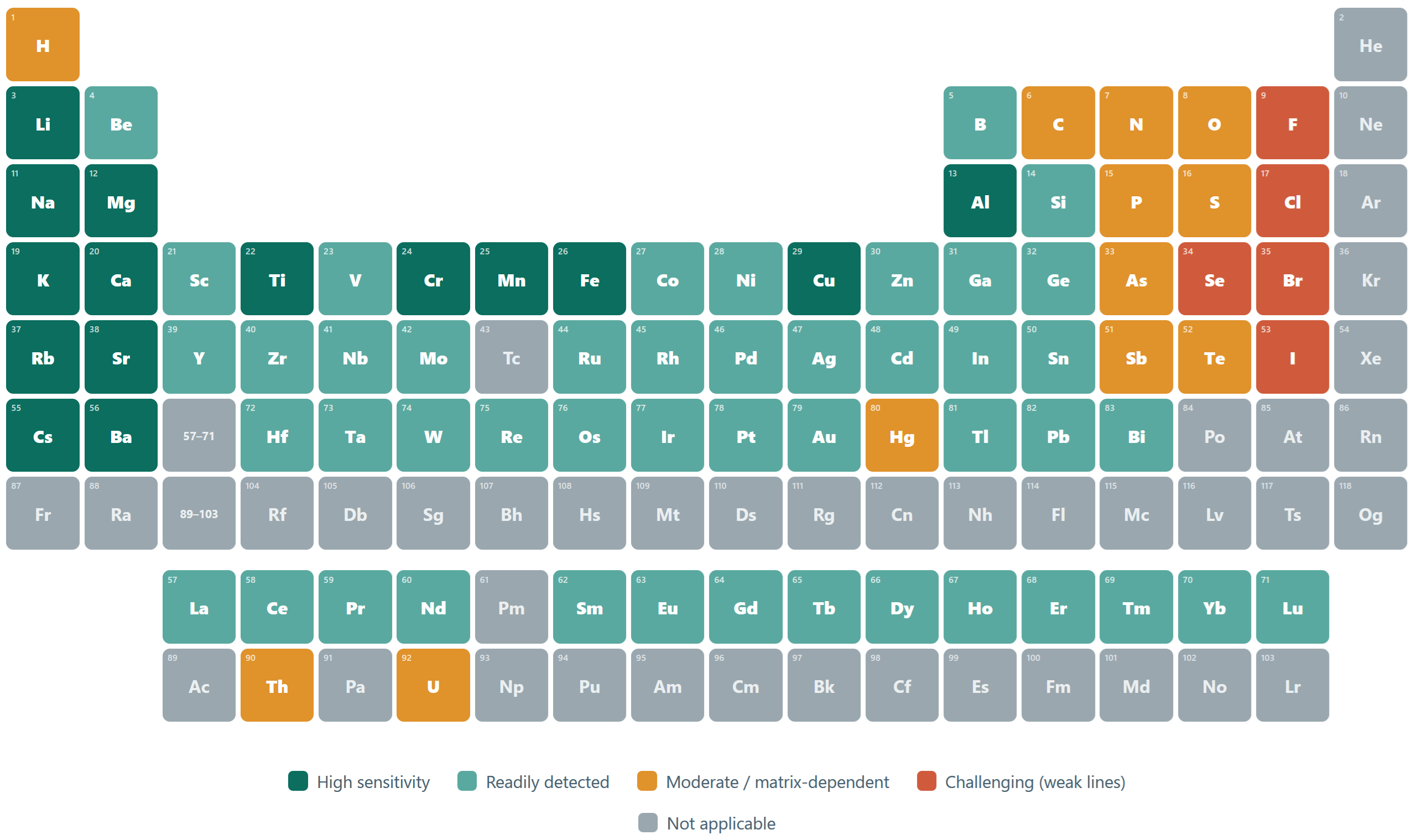
Indicative only: real detection limits depend on the emission line chosen, the sample matrix and the acquisition conditions. “Not applicable” covers the noble gases and short-lived / synthetic radioactive elements.
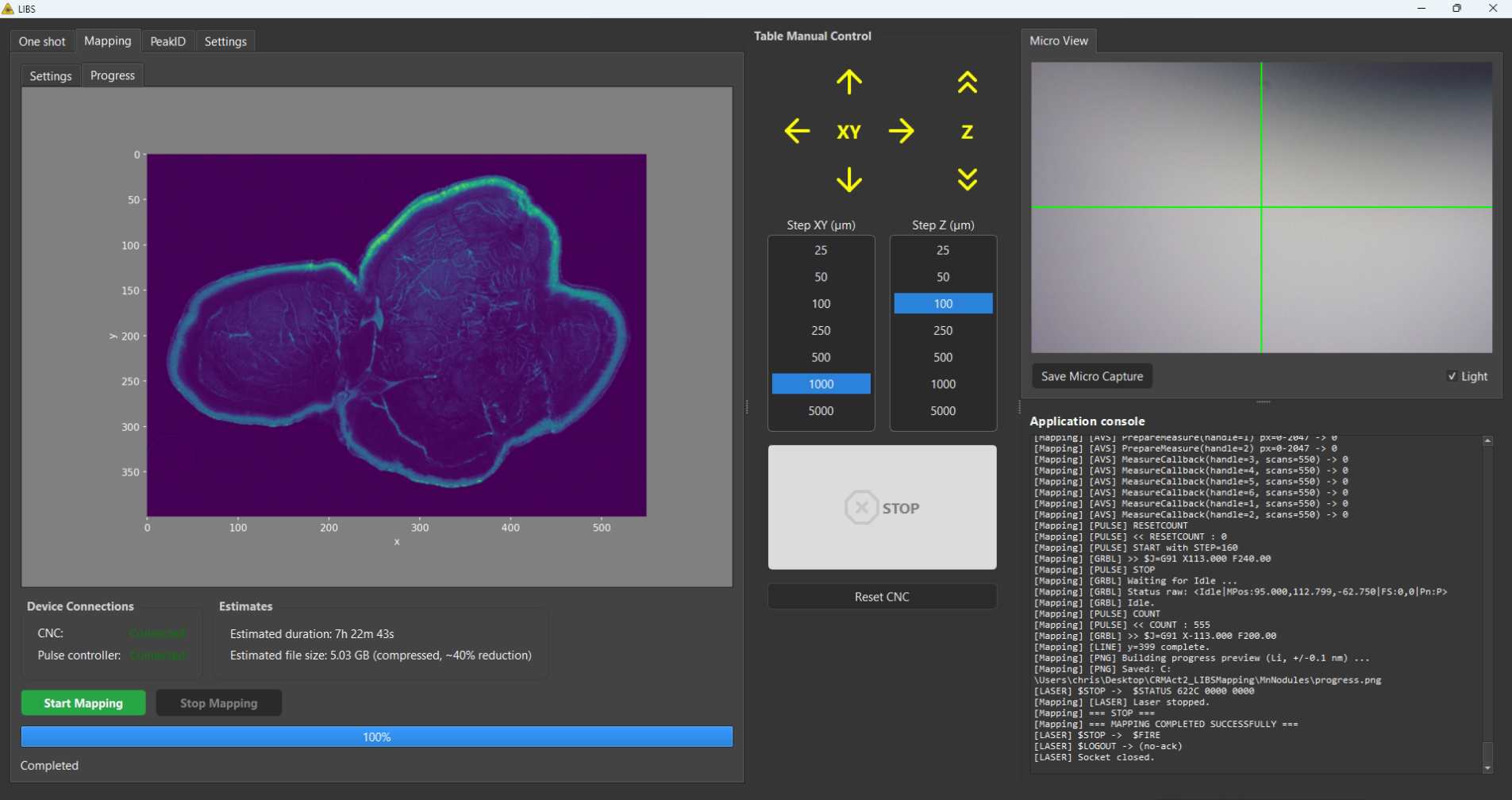
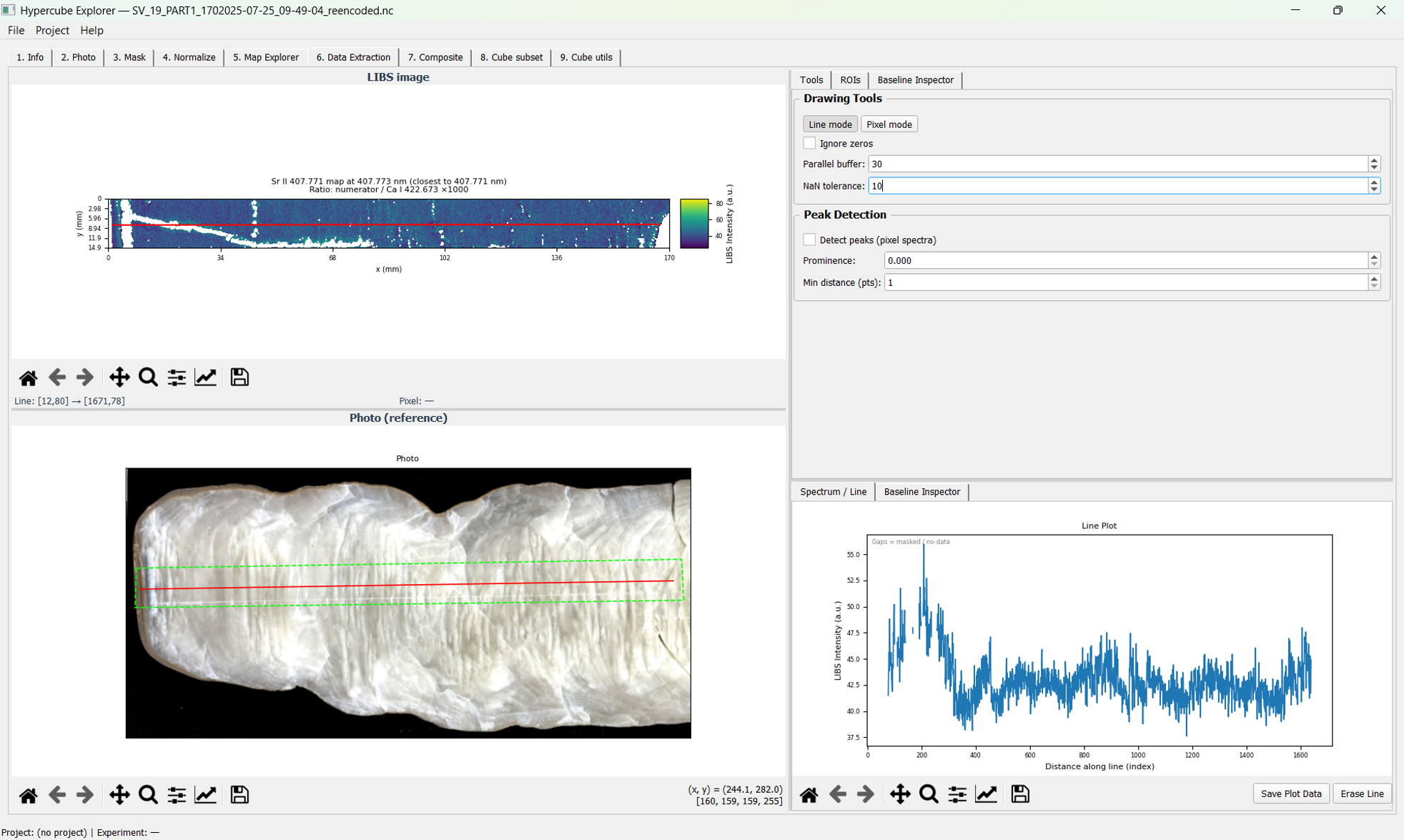
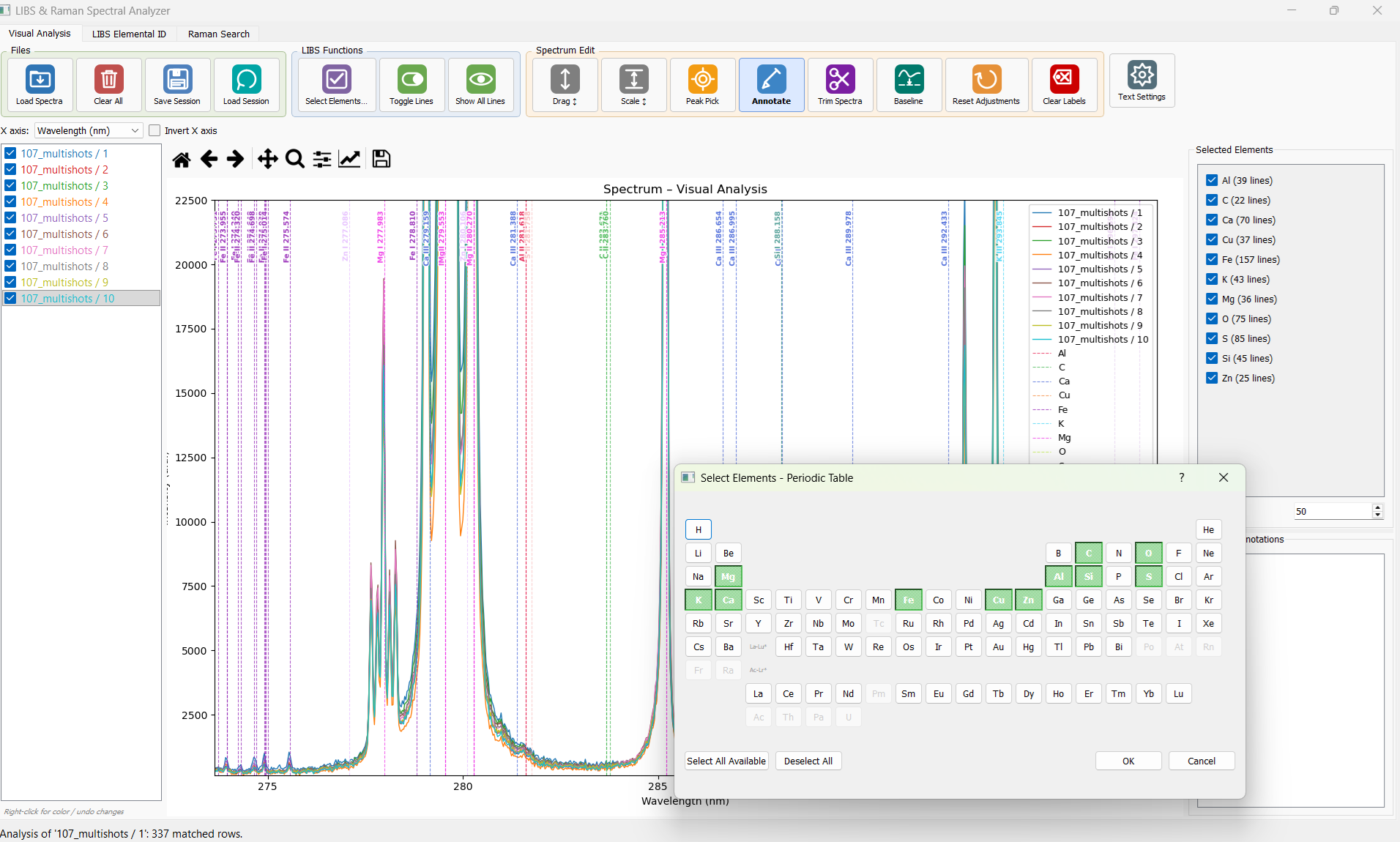
The lab runs a dedicated software suite — developed in house — to drive acquisition, explore the hyperspectral data cubes and identify spectral lines.
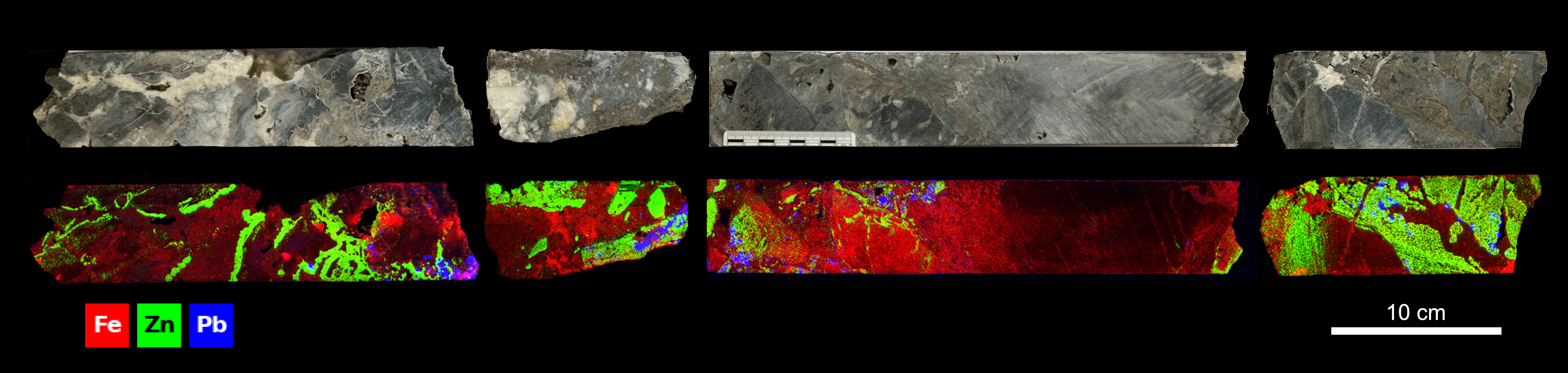
By mapping elements at the sub-millimetre scale, LIBS reveals zoning, mineral phases and the distribution of valuable and critical elements across a sample.
The lab develops compact, hands-on LIBS demonstrators to share the science of laser spectroscopy with the public. At science festivals and public events, visitors of all ages can fire a real micro-laser and watch the plasma reveal the chemistry of soils and minerals first-hand.
Our portable demonstrator pairs an education-friendly build — laser, fibre optic, spectrometer and motorised stage — with the same principles that power the laboratory instrument.
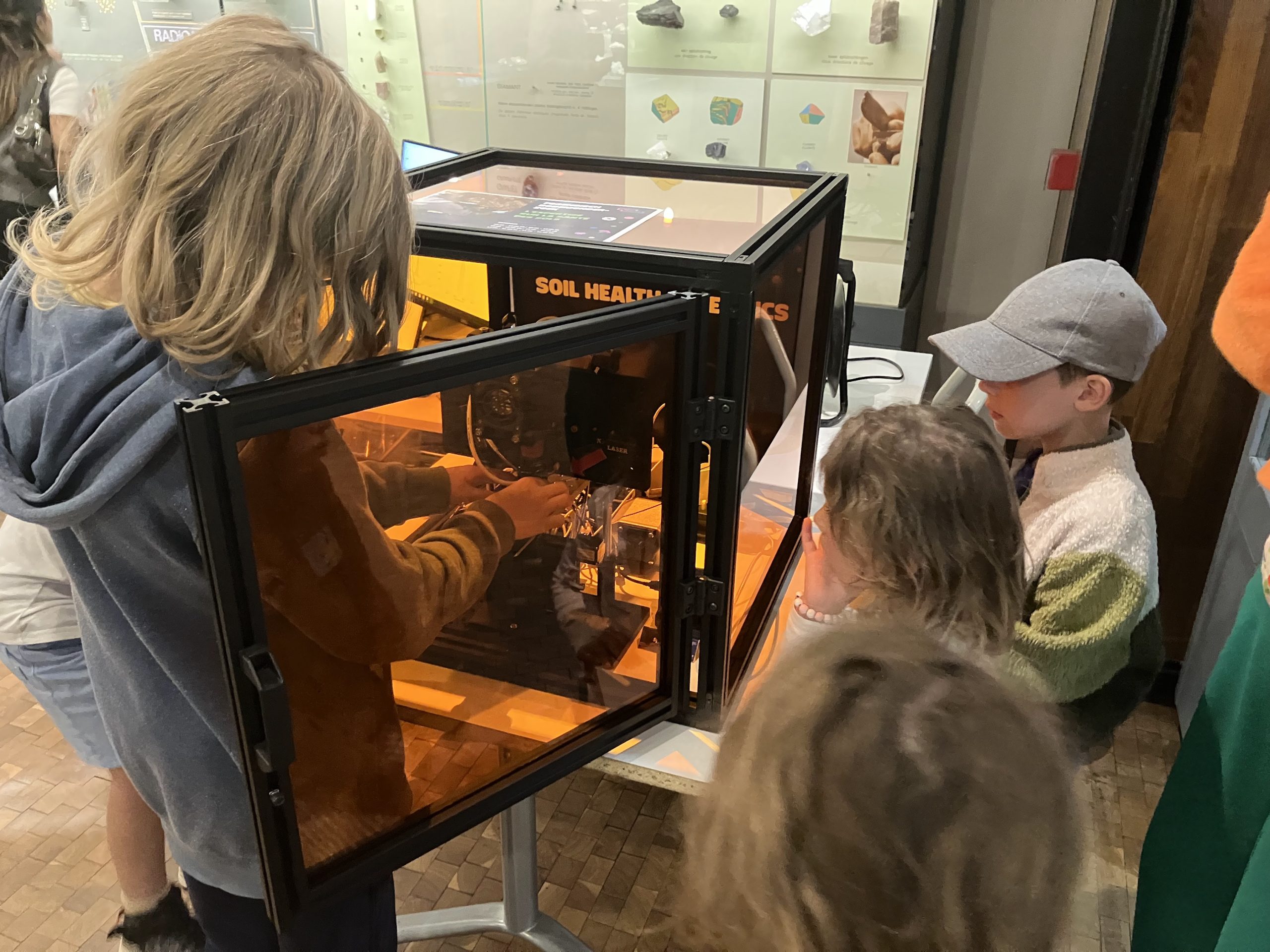
WiseNight 2025 — visitors at the mini-LIBS demonstrator.
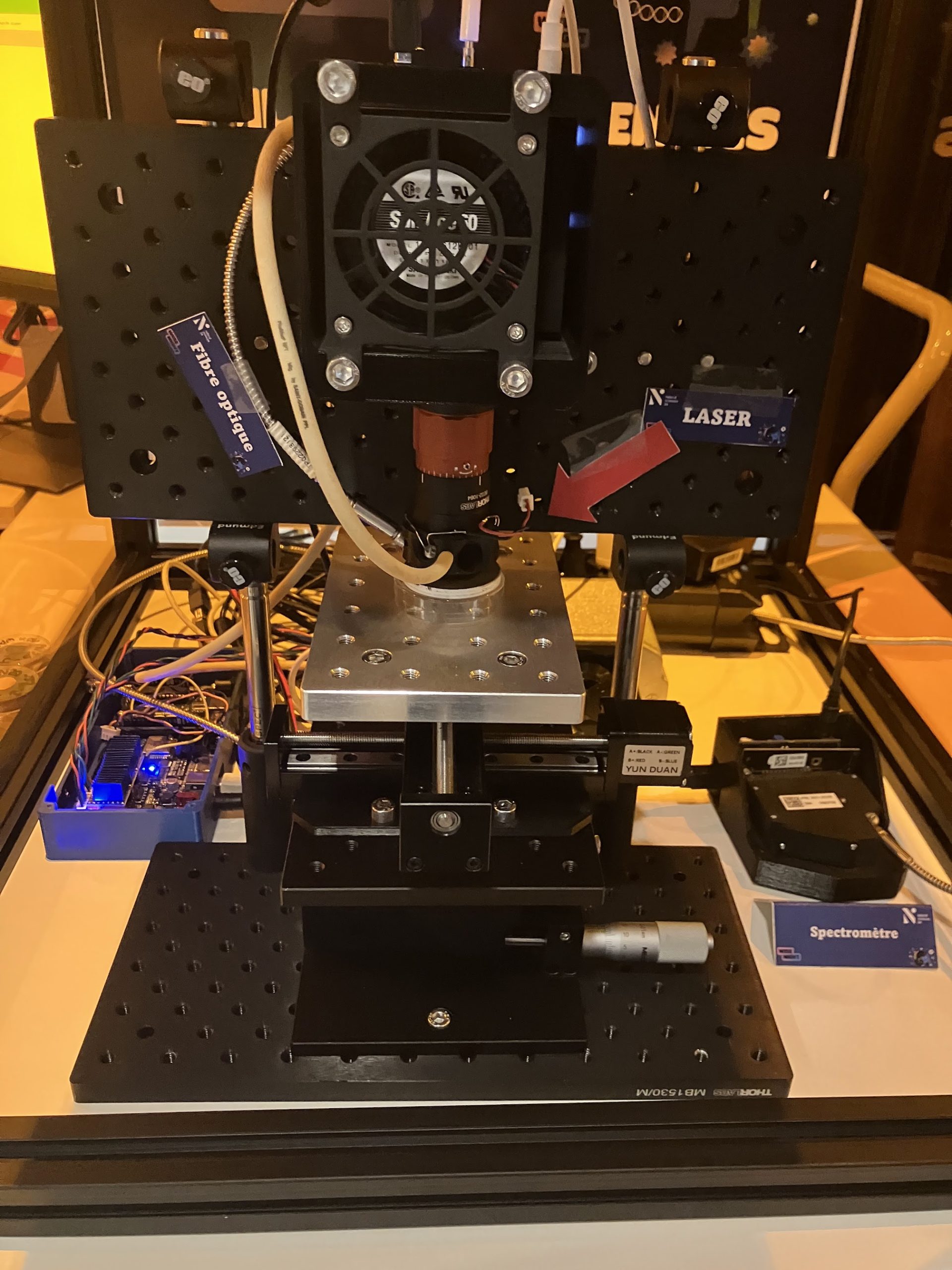
The portable mini-LIBS demonstrator built for outreach.
The LIBS laboratory supports research on mineral resources, palaeoclimatology, archaeometry… We welcome collaborations with universities, research institutes and private companies.