
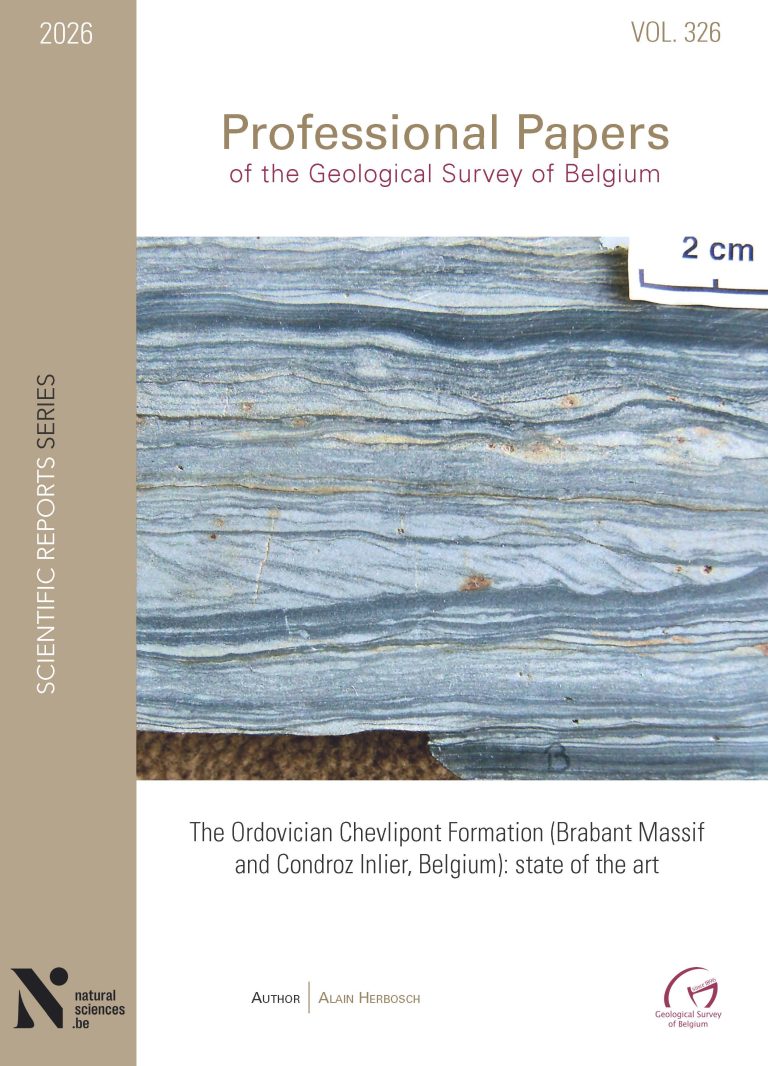
Professional Papers 326

The Ordovician Chevlipont Formation (Brabant Massif and Condroz Inlier, Belgium): state of the art

Professional Papers of the Geological Survey of Belgium - Vol. 326

The Professional Papers of the GSB volume 326 is now available for sale at the GSB. For ordering, please contact gsb@naturalsciences.be

printed copy: € 12.00 + shipping cost
electronic pdf: € 8.00

Publication details:

  • 37 pages
  • 10 figures, 4 tables, 3 photo plates
  • full color
  • soft cover
  • Alain Herbosch, 2026. The Ordovician Chevlipont Formation (Brabant Massif and Condroz Inlier, Belgium): state of the art. Professional Papers of the Geological Survey of Belgium, 326, 37 p.

See attached the cover, abstract and table contents and the first page of all the articles to have a first insight on the manuscript

PP326_Herbosch_2026_advertisement

ABSTRACT

  • The Lower Ordovician Chevlipont Formation is particularly noteworthy because, although not very thick, it can be observed in outcrops and boreholes over a wide area of the Brabant Massif as well in the Condroz Inlier. The main outcrop areas in the Dyle Basin and in the Marcq valley are described and illustrated with geological maps, together with a comprehensive inventory of boreholes in which the formation has been observed. The Chevlipont Formation also occupies a distinctive stratigraphic position, marking the transition between the Mousty Formation and a major hiatus that overlies its upper limit. The most common lithology consists of alternating cm-thick layers of siltstone, clayey siltstone, and mudstone, characterized by a distinctive wavy bedding. This lithology is the focus of a detailed sedimentological study. The results indicate that these facies correspond to truncated sequences of low-density turbidite. The predominance of low-density turbidite, accompanied to a lesser extent by high-density turbidite and the frequent occurrence of intraformational slumps and breccias, points to a distal turbiditic depositional environment with some gradient, probably situated in the lower part of the continental slope. Its early Tremadocian age is exceptionally well constrained by the presence of graptolites of the genus Rhabdinopora. Despite epizonal metamorphism, the silty lithology and low manganese content do not favour the development of metamorphic minerals. Studied phases include chlorite-mica stacks, chlorite, muscovite and ilmenite. New major elements geochemical analyses show that the siltstones of the Chevlipont Formation are well grouped within the Shales compositional field of lithological-geochemical classification and closely match international shale standards. These geochemical results are discussed and compared with those of the underlying Mousty Formation.