
BE.Hydrogen

National Geoscientific Exploration Programme for Natural Hydrogen in Belgium

Funding: Kyoto Fund/EU ETS by Belgian Federal Climate Ministry, through BELSPO

Total budget: 1 500 000 € (phase 1)

Duration: 2026-2028 (phase 1)

Point of contact: Kris Welkenhuysen, Estelle Petitclerc

BE.Hydrogen is a four-year geoscientific exploration programme, to create a first national overview of the natural or white hydrogen potential of our subsurface. The programme is coordinated by the Geological Survey of Belgium, part of the Institute of Natural Sciences, and the first phase of two years was approved and received funding of the Belgian federal government through the Kyoto Fund (EU ETS incomes).

Our objectives

The ultimate goal of BE.Hydrogen is to provide a map and geological model on the prospectivity of natural hydrogen in Belgium. We aim to create a territory-wide understanding and risk reduction for natural hydrogen exploration, as policy and decision support. In more detail, we will:

  • Create a state-of-the-art on natural hydrogen.
  • Evaluate possible mechanisms of formation, migration and accumulation of hydrogen.
  • Indentify favourable geological conditions.
  • Define suitable measurement methods.
  • Conduct detection field campaigns.
  • Provide a natural hydrogen model for Belgium.
  • Create an objective base for future policy decisions.

Result, output and events

Pontpierre visit, 26/05/2026

As the public BE.Hydrogen kick-off, a seminar and field visit with minister Crucke were orgnaised on 26/05/2026 to the REGALOR2 well in Pontpierre, France. This event received broad media coverage in national media.

Why look for natural hydrogen in Belgium?

While the chemical element hydrogen is present nearly everywhere, the natural occurrence of large concentrations in the subsurface has only very recently become a topic of interest. Hydrogen is used as a low-carbon energy source and as a raw material for chemical processes. A natural source of hydrogen can be of strategic climate and geopolitical advantage.

There are several generation mechanisms of natural hydrogen, the following are most applicable to the Belgian subsurface:

  • Maturation of organic matter
  • Radiolysis of water
  • Redox reaction of iron and water
  • Magma degassing

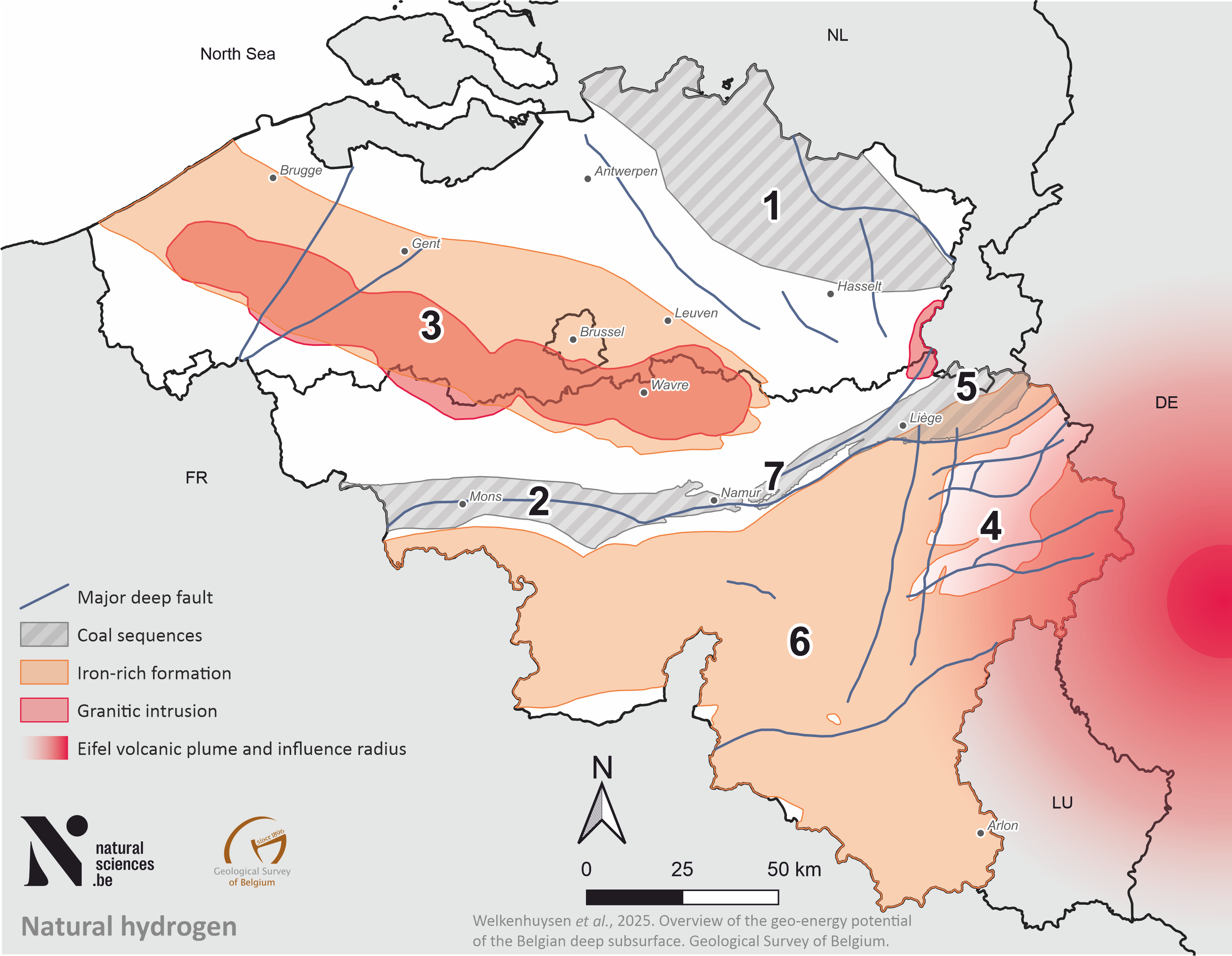
Early and high-level European prospectivity studies attribute a notable potential to Belgium, and a preliminary mapping of hydrogen-relevant structures [add link to report] will guide the early research steps.

The discovery of anomalous concentrations of hydrogen in Lorraine, France, and the presence of similar subsurface elements in Belgium has piqued interest in our own national potential. Because of the different geological context, a bespoke approach, tailored to the specific characteristics of our own subsurface is needed. And while Belgium is not a simple geological extension of Lorraine, the similarities make it an important opportunity for learning and collaboration.
Work plan

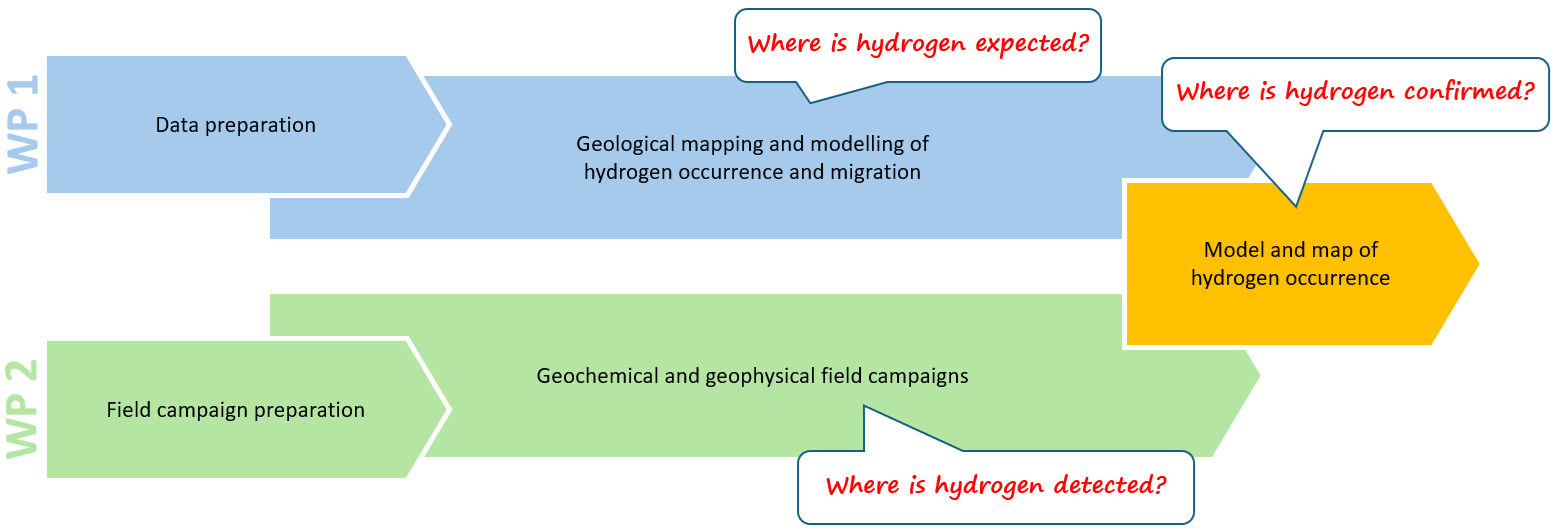
The BE.Hydrogen programme consists of two complementary and parallel research axes:

1. Modelling and mapping

  • Reviewing, reprocessing and re-interpreting existing data (deep) subsurface data
  • Mapping relevant structures and occurrences.
  • Structural (lithotectonic) 2D and 3D modelling considering the natural hydrogen system.

2. Field data collection

  • Identifying the most apt methods and measuring or sampling locations
  • Geochemical analysis of gas and water (surface and wells) and mineralogy (rock samples relevant to the natural hydrogen system).
  • Multi-Geophysics survey of the most prospective area(s).

Both axes are in an iterative process to identify the most prospective zones and feed new data to the model, resulting in a final nation-wide probabilistic prospectivity mapping and model for natural hydrogen.

While the data and workflow will be continuously evaluated, a mid-term evaluation will allow for an orientation of the research depending on the preliminary outcomes.
Frequently asked questions

What is hydrogen and what is it used for?

A toggle box content areHydrogen (H) is the lightest chemical element. Most people know hydrogen as a compound of two hydrogen atoms (dihydrogen or H2) a flammable gas, but it is also a building block of water (H2O), natural gas (CH4), and many other substances. Hydrogen is the most abundant element in the universe. In our society, hydrogen is used as a low-carbon energy source (for combustion or in fuel cells) and as a raw material for chemical processes (ammonia production, low-carbon steel production, methanol production, and other applications).a

What is white hydrogen?

Depending on its origin, hydrogen is assigned a colour. “White” hydrogen occurs naturally in the subsurface and originates from geological processes.

Is white hydrogen renewable?

The various processes that generate natural hydrogen are not yet fully understood, but it is assumed that these are continuous natural processes. Therefore, it can be considered a renewable source.

How much hydrogen is available in the Belgian subsurface?

General knowledge about the formation of natural hydrogen, geological processes, favourable conditions, and their applicability to the Belgian subsurface is currently still very limited. At this stage, it is impossible to make an informed estimate of available or commercially viable quantities. The BE.Hydrogen programme will create a solid scientific foundation for future assessments.

Where in Belgium can white hydrogen be found?

Hydrogen was not traditionally measured during underground explorations. Consequently, it has only been detected in very few locations in Belgium so far. The BE.Hydrogen programme will carry out systematic measurements in various areas of interest where existing knowledge and new analyses point to potential.

Does the “hydrogen bubble” in Lorraine reach Belgium?

The discovery in Lorraine raises expectations of a potential large-scale hydrogen reservoir that could extend across national borders. However, several geological factors must be evaluated to scientifically assess the true scale and significance of this find. To be clear, the hydrogen in the Lorraine subsurface is dissolved in the formation water; a gas bubble therefore does not exist. And although subsurface structures such as reservoir rocks and migration pathways often cross political borders, the exact source and geometry of the hydrogen reservoir in Lorraine remain unclear. Furthermore, the deep geology of the region is still insufficiently understood, meaning there is currently no conclusive evidence to determine the extension of this system into Belgium.

Will we drill for hydrogen in Belgium?

The BE.Hydrogen programme is the first systematic scientific study of the Belgian subsurface focusing on natural hydrogen. As this is in an early research phase, drilling for production, or even exploratory drilling, is not part of the programme. Should the results at a specific location prove favourable, further exploration involving drilling may be considered in the future.

Who is involved in the BE.Hydrogen programme?

The BE.Hydrogen programme is coordinated at the federal level and involves several public institutions and scientific actors. The steering committee consists of representatives from the office of Minister Jean-Luc Crucke, the federal Climate Administration, and BELSPO. Scientific coordination is ensured by the Institute of Natural Sciences – Geological Survey of Belgium (RBINS-GSB). Additional scientific and technical partners will gradually join the project consortium as the programme progresses.

What is the expertise of the Geological Survey of Belgium?

The Geological Survey of Belgium, part of the Institute of Natural Sciences, is well placed to lead a national research programme on natural hydrogen. Since its establishment in 1896, the GSB has been the federal reference centre for geological knowledge and subsurface data in Belgium. It possesses unique and internationally recognised expertise in geo-energy, sustainability and exploration. In addition, it manages the principal national physical collections of rock samples, drill cores, historical drilling data, digital data, and materials essential for such research.

Why could the presence of white hydrogen be important?

In the current geopolitical context, where both climate change and energy security are central, natural hydrogen could offer a renewable and low-carbon natural resource for energy and other applications. A domestic natural resource provides strategic advantages such as security of supply and price control.